
In my time on Twitter I’ve seen an explosion of CPD on offer, from advertisements for courses, run by consultants or consortiums, to generous freebies all expertly choreographed by not for profits such a ResearchEd, BrewEd and LitDrive.
All of which have contributed to the complex conversation that is education. In my experience these organisations have not only brought to the forefront educational research, subject specific knowledge and pedagogy, but have also helped to build a community of teachers thirsty for more. They’ve added colour to the tapestry of CPD.
Having run an entirely scientific Twitter poll, with 500 respondents (not a bad a sample size!) 68.6% of people were doing more CPD now, compared to previous years. That’s 343 people working in education, who are spending more time on CPD. Even if that’s just 1 hour each, that’s a whole lot of time.
I’ve benefitted immensely from this discourse: my views have been challenged, my perspectives have been widened, I’ve seen concepts through differently lenses and I’ve learnt a lot!
But, I’m worried.
Is this CPD genuine professional development or are we in the dangerous territory of ‘Cos People Do it?
Our time is precious, as is our knowledge. I have seen and heard conversation upon conversation about the bad old days of edu-tainment, of verbal feedback stamps and generally the prioritisation of engagement and demonstration of learning over, well, actual learning. Yet, how did we get to that point? My view is, we traversed a road of half-heard messages, good ideas, best intentions and things that looked good on paper. But aren’t we in danger of that now?
Just because someone quotes Dylan William, does it mean hours upon hours spent pouring over individual marking and feedback is the right thing? Likewise, just because we are quoting Sweller, Bjork and Counsell, does it mean we truly know about cognitive load theory, retrieval practice or curriculum? Saying it doesn’t make it so.
Except, it does. Saying it does make it so for those who listen on intently, with the eagerness and drive to do something about what has been said. To go away and tear up curriculum plans to start afresh. Which leads to copious amounts of work, time spent, evenings and weekends devoted to change making.
But just like the nightmare legacy of learning styles and brain gym, what happens if we’ve got it wrong? I don’t mean the work Sweller, Bjork and Counsell, but us.
What if the CLT, the retrieval, the curriculum become the half-heard messages, good ideas, best intentions and things that look good on paper? Then where do we go? Because for all the marvellous CPD that is out there, there are things that are wrong, there are things that are misconceived. And they are all delivered without malice, ill intention or lack of effort. But that does not change the potenital impact this could have.
After all, what all of this boils down to is our students. Whatever the cause, the impact lies firmly at the feet of our classrooms.
We are supposed to ‘do’ CPD to improve things for our students, one way or another. Be that less time wasted on ineffective revision strategies, or more time spent on curated explanations. But, if we misunderstand these things, if they become ‘lethally mutated’ then it our students who suffer. And us too. Our time is precious.
For more on lethal mutations, see the BrewEd Cleethorpes panel discussion here.
Evaluation: The golden thread of effective CPD
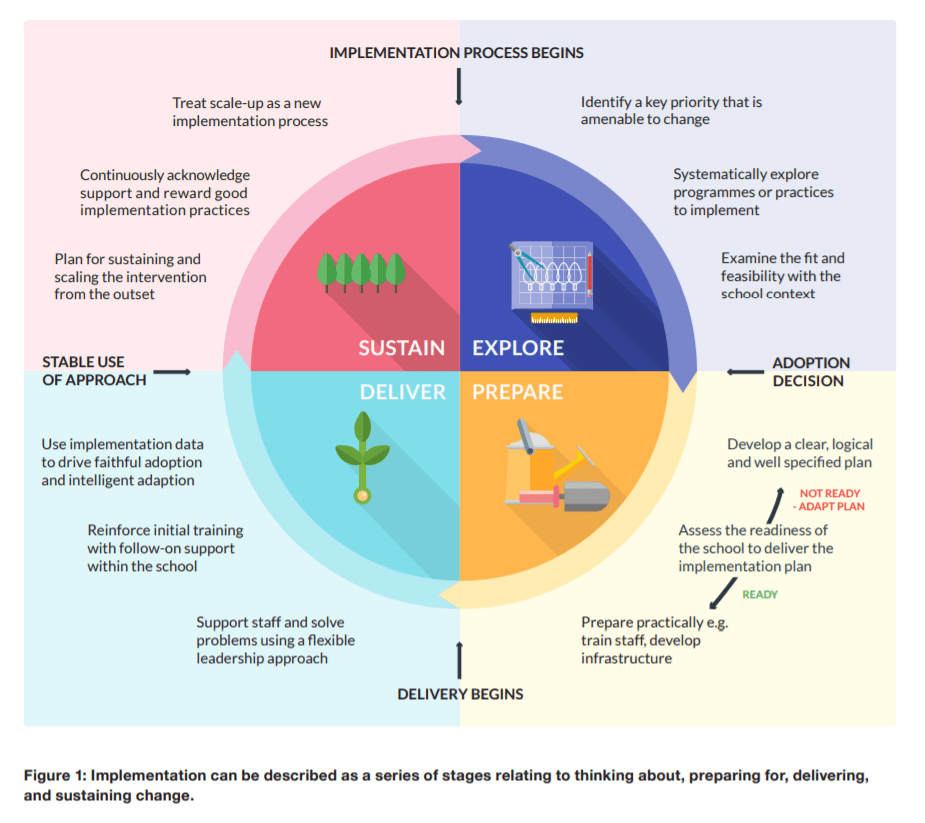
If we examine work on Implementation by the Education Endowment Foundation, it is clear that evaluation sits at the heart of effective CPD. I mean that literally and figuratively. Evaluation should be the golden thread throughout all CPD programmes, with opportunities to pause, reflect, change, adapt or adopt initiatives. So where does this fit in with our own CPD? The personal stuff we are doing at weekends, online, in the evenings, the free stuff, the paid for stuff and everything else in between.

Well, we have to take responsibility for that. Ourselves.
Last year I asked a question about CPD, it was at the time I started writing this blog, as is the lengthy nature of my blogging process!
The concept of accreditation was questioned. Accredited by who was the main question. It is something I am still considering. In the absence of a suitable answer, I propose a few more questions.
In a previous blog (here), I talked about being a critical consumer of evidence:
Using research alone is not a silver bullet. We have to be a critical consumers of evidence, be cynical, be dubious, question everything! There is literally tonnes of research evidence out there, some of which may not be as reliable as others. Always look behind claims, check the reliability of studies, for example ask yourself:
- What is the cohort size?
- Are there any sponsors for the study? Who are they? Are they invested in the outcome?
- Does this study fit your context?
- How was the data collected?
Essentially you are sorting the metaphorical wheat from the chaff. Giving your school initiatives the best chance of success.
This remains true for CPD we are exposed to. We should all evaluate it, whether we are given the opportunity to or not by the presenter.
Let’s ask ourselves:
- Is this based on evidence, research or personal experience?
- Is that evidence, research or personal experience relevant to my context?
- Is it well referenced?
- Can I check those references to check for accuracy?
- Is there ego or rhetoric involved in what I have seen or heard?
- If so, does that effect the quality of what I have seen or heard?
- Does this seem too good or too simplistic to be true?
Platforms, having a voice and having responsibility.
Being online, presenting and delivering CPD and using your voice is a responsible position to be in. It is also one of privilege. Utilising your time whether to give or receive CPD is a precious resource, as are the consequences and impact of that professional learning. Everyone invested in this process has a collective responsibility to quality assure it through honest, compassionate and rigorous evaluation. Whether that is personal reflection, professional conversations or probing reading.
Bibliography and reading
- https://www.tandfonline.com/doi/full/10.1080/02619768.2010.534131
- https://www.magonlinelibrary.com/doi/abs/10.12968/sece.2015.30.7
- https://educationendowmentfoundation.org.uk/tools/guidance-reports/a-schools-guide-to-implementation/
- Guskey. T. “Evaluating Professional Development” (2000)
- Robinson. V “Reducing Change to Increase Improvement” (2017)
 Miss Understanding Education
I found this a very interesting read, thank you. You’re absolutely right in that many – in fact probably all! – CPD claims to be evidence-based, but that the quality of that evidence varies greatly. And also it’s the natural tendency to lose details in favour of the headline, which means in some cases the conclusion isn’t relevant for our year group or curriculum area. I completely agree that we need to consider the context of the shared research when thinking about if and how to apply it to our situations. What I try to remember is that research is almost never a clear instruction, of “Do this and all will be well.” Instead, it’s better thought of as a useful guide to which methods and approaches to try first, and which are so rarely useful that they’re a waste of precious time.
Often it’s not about stopping things which don’t work, but about swapping an approach which is okay for one which is better. In the same way as we test new painkillers against existing ones, we are almost always trying a new classroom technique which will replace what we did before. Using an ineffective resource or method is an opportunity cost, because it does not allow us time to do something better in its place. The only way to improve the experience of our learners is to evaluate the different approaches in use, with our kids, in our classrooms.
There’s a useful way to think about any CPD offering which we are considering for our own use:
Engage – pay attention to the CPD evidence, ask questions, think about necessary adaptations (and if they will be so great to make it a ‘harmful mutation’)
Experiment – try it with students, thinking about how you will judge the success or otherwise of the technique
Evaluate – did it make a difference to the student outcomes you consider important? how much time and energy did it take?
Embed or Eliminate – depending on the evaluation, you will either iterate (which, realistically, every teacher does each time they teach!) or reject it. If you are going to develop it, you need to build it into your practice until it becomes a habit. If not, then you should have a clear reason you can explain to others about why it is not appropriate at this time.
LikeLike