
I am currently studying for a MA with The National College of Education (@TheNCE_). If anyone is looking at developing their understanding of leadership and wants to do it through the process of MA and Level 7 apprenticeship, then I thoroughly recommend them. Their support, quality of communication and content is really good. So go for it! But that is not the point of this blog.
Warning, please don’t expect this to be overly insightful.
I normally find writing relatively easy. I am not saying I am particularly good at it, and the more I write, the more I realise that my level of literacy is probably significantly below the cocky 18 year old A-level student who was far too fond of using ‘quintessentially’ just to prove how smart she was. However, it is a release, almost cathartic, because I write about something I am comfortable with and generally just want to convey my thoughts or iron them out a little, which writing helps me to do. However, I have come unstuck. I am learning about new content, which isn’t exactly easy. Leadership is something I have ‘done’ for a while now, in a variety of capacities, mostly by instinct, often by trial and error (emphasis on the latter) and seeking inspiration from those around me. But now I am a fully fledged student and my understanding needs to be sharper and don’t get me started on the referencing!
So, I thought, maybe writing a few blogs on what I am learning will help me iron out some of my thoughts on the content, before I formalise it into academic writing. So here goes. that’s what I am going to do. I hope it works!
Culture
As part of my current module I need to understand and critique culture. What on Earth is culture?
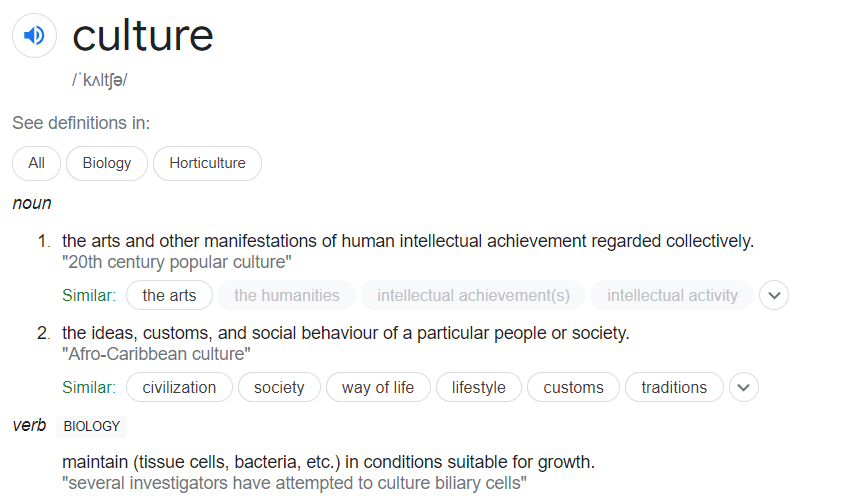
Being fairly certain that the culture I am referencing is not the verb variety I am left with two options:
- The arts and other manifestations
- The ideas, customs and social behaviour of a particular people or society
For the purposes of clarity, the culture I am striving to understand is option 2:
The ideas, customs and social behaviour of a particular people or society
My thinking around this and how it translates to schools is perhaps superficial in this first assertion; that culture is actually the culmination of what makes your school unique. That melting pot of ingredients that makes it just so. But the trouble with that is, because our schools are made up of people, each with their own life experiences, biases, thoughts, knowledge, behaviours, it make make culture become that ‘je ne sais quoi‘ of the educational world (well, any organisation really.) It is also a low validity domain, which further complicates the idea of quanitfying what it is.
Ina a recent @EdClubhouse chat Carly Waterman explored the idea of school culture:
Which voices get amplified and which voices get silenced by the structural acoustics of your school culture?
Carly waterman
In light of the confusion and questions (and an impending essay) I need to explore what the academics say. So, here is my reading on and around the idea of culture, touching on values and vision.
The Culture Map – Erin Mayer

This book was assigned as pre-course reading and it is a really fascinating insight into how cultural differences from country to country impact upon multi-cultural, multi-national organisations work; more importantly how we can overcome cultural differences in communication to make more harmonious, productive and efficient working relationships.
There are 8 areas the book explores:
- Communicating: low-context vs. high-context
- Evaluating: direct negative feedback vs. indirect negative feedback
- Persuading: principles-first vs. applications-first
- Leading: egalitarian vs. hierarchical
- Deciding: consensual vs. top-down
- Trusting: task-based vs. relationship-based
- Disagreeing: confrontational vs. avoids confrontation
- Scheduling: linear-time vs. flexible-time
Whilst only one strand is explicitly entitled communication, I would argue that they all culminate in nuances of our communications, and are just aspects of it. This has really made me reflect on my communication with colleagues and theirs with me. I have been guilty of the assumption that some people are ‘just bad communicators’, and may be that is true, but it certainly isn’t helpful. The dismissive judgement, I realise, only provides a barrier to a successful working relationship.
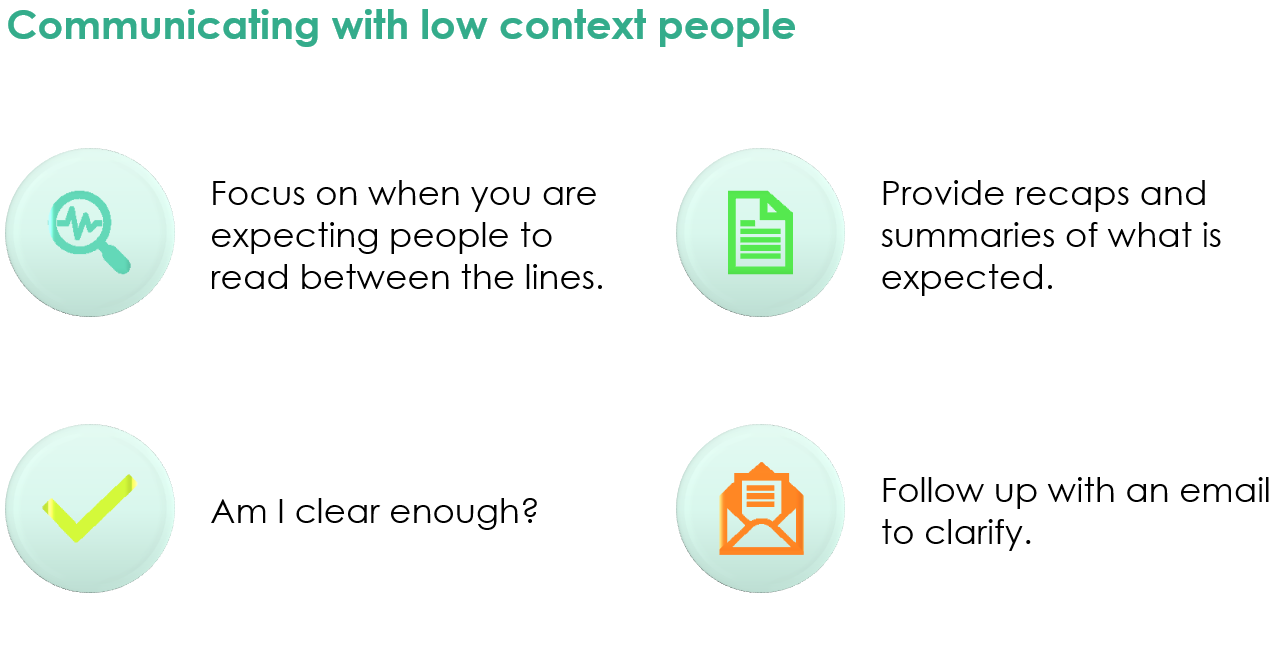
One of the difficulties in communicating across cultures is the level of context we have with one another, and the how context-dependent a particular culture is.


My current place of work is not particular multicultural. It is located in a largely middle class area of East Yorkshire. The 2011 census highlights that “Beverley has a higher level of residents born in the UK than the national average and a lower rate of residents either born in other EU countries or outside the EU, it does not have a significant immigrant population.” (https://www.ilivehere.co.uk/statistics-beverley-east-riding-of-yorkshire-3401.html). This is represented in my colleagues too, although not exclusively.
So why is the concept of high-context low-context communication important to me in my context?
What particularly resonated was the concept of context-dependent communication being a spectrum, upon which there are no specific co-ordinates for your own culture, but more a generalised locality. This means we are each free to traverse along the spectrum to meet a middle ground with all of those we are communicating with.
The fact that no two of us are exactly same, even if we belong to the same culture, means we will each have different contextual reference points, all of which could add to or seriously hinder communication. Therefore, understand the contextual ‘level (?) of your colleagues may be important if you find that you are struggling to communicate with one another. The book suggests the following strategies for communicating with people out of our context:

Now, to consider why the concepts in this book become important to our development and stabilisation of culture within an educational setting.
It is critical that we attempt to move forward as one, even if we have conflicting beliefs. without that strong culture we would find it difficult to move forward cohesively. If everyone doesn’t buy in and enact our culture, is it a culture?
Therefore, we need to decide and achieve buy in to what are we? What we stand for? What do we believe in? What do we work towards? Ultimately, what is our culture?

So, as a culmination of all of these subsections, we end up with layers of culture.
I would question, how we would approach culture building and embedding. If we have a cohesive staff and student body, if we are ‘all rowing together’ then do we assume that we are working at the same point on the continuum for culture?
If not, we would need to pin point where there are barriers. Where are the missing ingredients for cohesion?
How could we do this? Can we really change people, at their core? I would argue that this is highly unlikely, however, we still need to achieve our end goal, assuming our goal isn’t the issue. Therefore, spending time contracting on agreed behaviours, in actions such as those mentioned above, would be essential, in my opinion.
How does this differ in existing schools vs start ups?
Overall Justice, Work Group Identification and Work outcomes – Charmi Patel et al.

This paper focuses on the perception and practice of justice in a context specific organisation.
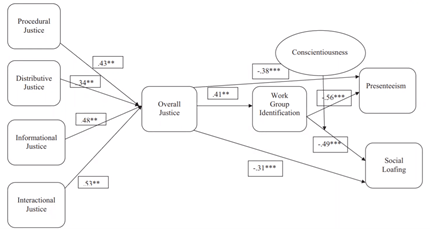
The paper used 458 usable responses to survey in their methodology.
We need members of our team or organisation to be proactive to give us a competitive advantage.
Positive work attitudes and extra role contributions are important to deciphering motivational factors that are at play.
Employers do good things for employees; therefore, employees will reciprocate. (someone who is appreciated will always do more than is expected).
4 components:
Procedural
Distributive
Interactional
Informational
How fairly they are treated by all aspects of their workplace (organisation, co-workers, supervisors)
Overall perception of fairness
All aspects of justice, as a total add up to the totality of an individual’s experience of workplace justice.
Better experience of the workplace = more beneficial outcomes for both parties.
Individualist cultures: (In the West) Individualistic culture is a society which is characterized by individualism, which is the prioritization or emphasis of the individual over the entire group. Individualistic cultures are oriented around the self, being independent instead of identifying with a group mentality.
Collectivist cultures: (In the East) Collectivist cultures emphasize the needs and goals of the group as a whole over the needs and desires of each individual. In such cultures, relationships with other members of the group and the interconnectedness between people play a central role in each person’s identity.
- What is work group identification?
- An individual’s behavioural effort on behalf of the collective to which they belong, which is influenced but how the individual thinks and feels about themselves.
- This can also relate to counterproductive work behaviours such as presenteeism and social loafing (but is moderated by conscientiousness).
- Social identity is affected by the processes and treatment an individual encounters in their work groups.
Fairness is key.
Those working in teams are likely to reduce effort, especially if it is a large team. There needs to be personal responsibility for all individuals.
- How does conscientiousness feed in to preventing absenteeism or social loafing?
Absenteeism and social loafing are both counterproductive work behaviours. These are associated with an intentional act by employees that harm an organisation or its stakeholders.
The fairer or just an individual views the organisation the less likely to participate in CWB.
Conscientiousness is a personality trait: Planning, thoroughness, hard work & purposeful striving towards goals. This can negate a tendency towards CWB
- How is this relevant to schools?
Challenges to the article:
The study was carried out in a different context to ours:
- Type of organisation.
- Type of culture (collectivism Vs individualism)
- Mean length of education.
- Distribution of gender.
- Different length of tenure.
However, ensuring an organisationally just environment that is perceived as being fair, when coupled with conscientious employees is likely to lead to overall greater productivity.
This is essential in the current times, as productivity and adaptation to change is essential to deliver market demands (online education).
Fairness: Autonomy over delivery of lessons, understanding and agility around childcare needs and other responsibilities. Openness about changes.
Conscientiousness: Are educators as degree educated professionals automatically conscientious?
Unfairness: Not providing enough training at the appropriate points to make employees feel safe and confident in the climate.
Our staff all sit somewhere on this continuum. Identify and address:

Something to consider: How does our perception of justice and fairness link in with our own culture and values?
Relationship Between Innovation-led HR Policy, Strategy, and Firm Performance By Hoa Do et al.

Innovation:
- Loyal customer base
- Increased efficiency
- Competitive advantage
Success in innovation is influenced by:
- Leadership style
- Organisational learning
- Organisational structure human capital
- Work environment
- Key points for this journal?
- Innovation for innovations sake? Link to Vivienne Robinson work on less change more improvement
- Innovation strategy alone is not enough to secure innovation (it should be complemented with other strategies too).
- HR practices that shape employee creativity produce innovativeness and are a source of competitive advantage.
- Eg task autonomy, employee empowerment and extensive training
- Innovation strategy + Innovation led HR strategy = improved performance (success)
- Alignment to other areas of the organisation is key to make sense of its application
- Servant leadership: followers of a servant leader are more willing to experiment with new ideas because there is a strong sense of psychological safety in this relationship.
- How can I relate this to school leadership?
- Utilising the features of servant leadership with colleagues can provide the platform and confidence for them to feel able to innovate and improve their performance.
- What might I be able to use in the essay? Critique how vision, culture and values underpin strategic leadership?
- How do we align our strategy to our practices across the school?
- During COVID is servant leadership really appropriate? We expect people to openly innovate, however, we also need to dictatorial to comply with national policy. So, servant leadership as a culture is more important prior to the event than during the event itself. Long termism and short termism
Key Stakeholders’ Perceptions of Effective School Leadership – Odhiambo and Hii
Data taken from semi structured interviews from one large girl’s Catholic school in Sydney, Australia.
How do teachers, parents and students perceive school leadership in practice?
- Impact of leadership is measured by stakeholders in terms of school organisation, efficiency and overall effectiveness and was influenced by their perception of the principal’s leadership directly.
- It is important for the school principal to establish positive working relationships with individual teachers and students to ensure the effective running of the school.
- Personal interaction was considered invaluable and promotes open and affirming nature of the school.
- Other researchers (eg Beatty, 2007:388)* found in accordance with this and therefore, principals should set aside time for meaningful collaborations to build relational trust.
- Although, the paper recognises this can be difficult and can be uncomfortable.
- The true measure of effectiveness was as result of the dedication and commitment of school leaders.
- Effective communication of vision is essential to leaders performing their role.
In short, this paper would indicate that stakeholder perception of school leadership is driven by the principal. Therefore, the culture is driven by them in a top-down model.
I am not entirely sure I agree with this point. Whilst the principal may be integral is being the public image of culture, it should be breathed throughout the school, and experienced by everyone. This is supported by Vivianne Robinsons work on espoused theory vs theory in use. (Robinson – Reduce change to increase improvement).
*Going through the emotions: leadership that gets to the heart of school renewal – Brenda Beatty
This paper looks at ‘safe emotional spaces’ for learning and growing together.
Shared / distributed / distributive leadership can be utilised to induce change within a school if school leaders take in to account the emotional experiences of stakeholders.
Evaluating the impact of professional development: the need for a STUDENT-CENTRED approach – Earley and Porritt

The model above links coherently with the Teacher CPD standards – https://assets.publishing.service.gov.uk/government/uploads/system/uploads/attachment_data/file/537031/160712_-_PD_Expert_Group_Guidance.pdf
The link to impact evaluation is highlighted as being a key player in PD that impacts students’ outcomes.
High-performance work system practices in Vietnam: a study of managers’ perceptions. Journal of Organizational Effectiveness: People and Performance, 2019. Do et al
Research carried out with 17 managers from 17 Vietnamese firms.
Banking, pharma, telecoms, & insurance.
Definition of high performance work systems (HPWS): High–performance work systems (HPWS) are a group of separate but interconnected human resource (HR) practices – e.g. selection, training, performance appraisal, and compensation – designed to enhance employee effectiveness.
The findings of this article indicate that HPWS can impact both employee outcomes (attiyudes, behaviours and productivity) and firm performance (innovation, firm growth and profit growth).
HPWS are help promote human capital such as competence and motivation, which subsequently increases chances of organisational success. These are positivite influences for all involved.
The findings also indicate that HPWS are linked to innovation. This is interesting in times of COVID, given that innovation has been significantly important to our work practice in education.
(p.153) However, their findings of indicators of performance placed profit as the highest indicator for performance. This of course, could translate to educational outcomes for schools, although, this is questionable, since we are not making or selling a product or service. It is interesting to note that they ranked customer satisfaction as 4th and service quality as 7th in order of importance of performance indicators. I would argue this ranking would be different for the education sector.
Vision effects: A critical gap in educational leadership research: Sooksan Kantabutra
In their literature review they highlight that vision communication, organisational alignment, empowerment and motivation are important, which is supported by the findings of Do et al, who highlight this as an important factor is servant leadership. Both link these findings to organisational success however, in the current times, servant leadership, whilst a historic practice, has not been a practical approach to take.
So, these are my notes and ramblings so far. Now to make something more coherent out of it and make it sound a bit more academic. I’d recommend this process for some sense making, it has helped me immensely. I’ll even try it again!
 Miss Understanding Education